
01 · Catalogue
Structure, filters and search
Product data model, attributes, variants and bundles. Filters and search that stay fast across tens of thousands of products.
We design and develop eCommerce platforms for stores that have outgrown off-the-shelf solutions: tens of thousands of products, several warehouses, individual prices, and integrations with accounting and logistics.
When this needed
At first it looks like small inconveniences: slow filters, manual exports and “ask the developer”. Then every change to the range or prices costs days of work, and peak days become a risk instead of revenue.
If you have 500 products, one warehouse and simple pricing, we will say plainly that you do not need a platform and recommend a less expensive solution.
Scope
01 · Catalogue
Product data model, attributes, variants and bundles. Filters and search that stay fast across tens of thousands of products.
02 · Sales
A purchase flow with minimal steps, delivery and payment, repeat orders, a customer account and B2B terms.
03 · Data
Exchange prices, stock and orders with ERP or 1C, delivery services, payment systems, CRM and analytics.
04 · Control
Categories, banners, landing pages, promotions and SEO fields are editable without a developer. Changes go live the day decisions are made.
A platform is not a set of features. This is the speed at which the business can change.
Architecture
We compare an off-the-shelf platform with custom development by three criteria: the cost of launch, the cost of change and the cost of scale.
An off-the-shelf platform wins when it covers most requirements without rewriting its core. Custom development is justified where unique business logic creates a real advantage. We document the decision with the numbers behind it—not persuasion.
Stability
Caching, indexing, query and image optimisation. We test with a real data volume, not a demo catalogue with hundreds of products.
Core Web Vitals · Load testing
Queues, retries and an exchange log: if accounting is unavailable, orders are not lost and the buyer sees no errors.
Queues · Data-exchange monitoring
Before development, we agree which system controls prices, stock and statuses. This removes most conflicts after launch.
Data-exchange rules · Backup copies
01
30-minute meeting
Range, current system, integrations, constraints and timelines. We will say whether you need a platform.
02
Analysis and architecture
Product data model, purchase scenarios, integration map, decisions and total cost of ownership.
03
Design and development
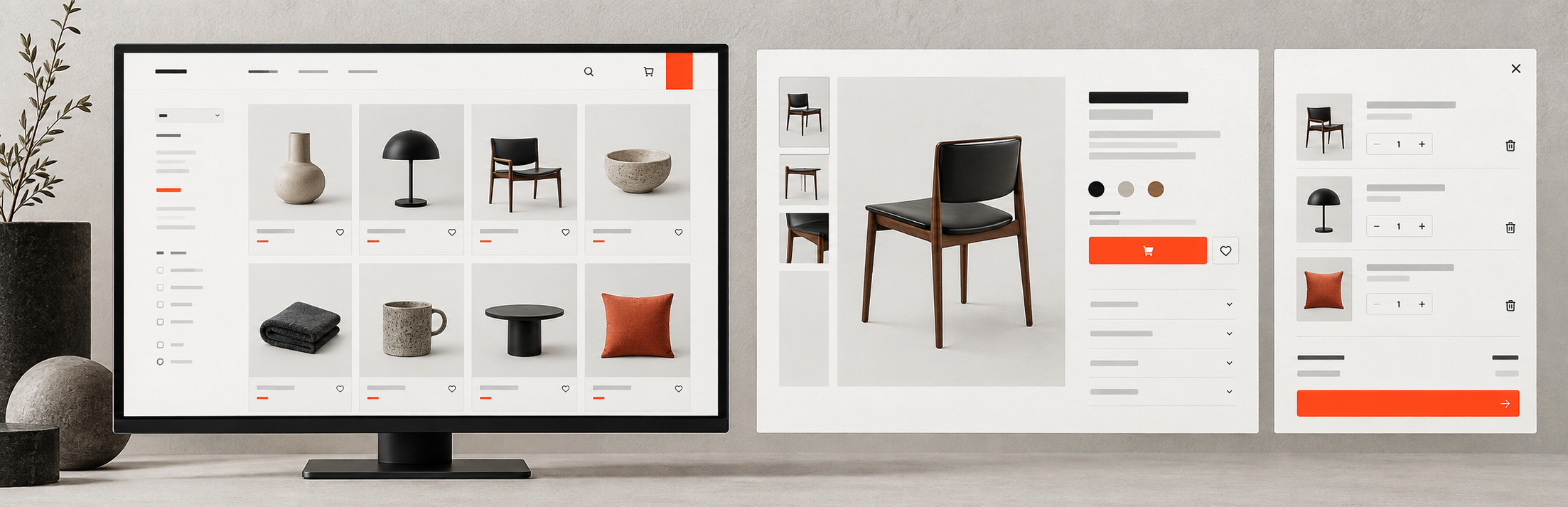
Catalogue, product page, checkout and portal. We release in parts so you see results before the end of the project.
04
Launch and growth
Data migration, SEO preservation, load testing, team training and a change queue for the next quarter.
Cost
We estimate development after analysis: without it, any figure would be made up.
Analysis and architecture3–4 weeks
from $3 500
Data model, integration map, decisions and a release plan with budget.
Development platformsfrom 3 months
from $20 000
Full cycle: design, development, integrations, data migration and launch.
Questions
An off-the-shelf CMS works well up to a certain scale: several thousand products, one warehouse and simple pricing logic. A platform is needed when there are tens of thousands of items, several warehouses, individual prices, B2B portals and accounting integrations. The difference is not in design, but in data architecture and the speed of change.
We first calculate what is cheaper in your case. If a ready platform covers 80{85c32a404beb3a17fad9859395e98171d5844d669a872c9f6728ab61e397d515} of the requirements without rewriting its core, we use it. We recommend custom development where unique business logic creates a real advantage.
A first working version with a catalogue, checkout and basic integrations usually takes 3–5 months. Exact timelines depend on the number of integrations, the state of product data and how many processes are moved from the old system.
This is part of the project, not an add-on. We agree which system is the source of truth for prices, stock and orders, how often data is exchanged and what happens when it fails. Without this, the store sells what is not in stock.
We build in caching, queues for heavy operations and load testing before release. We test the scenarios that fail on Black Friday: catalogue, search, cart and checkout.
Your team. Categories, banners, landing pages, promotions and SEO fields are editable without a developer. Filling the catalogue with products is a separate service, quoted separately.
Start
A 30-minute online meeting with the founder. We will review your range, current system and integrations. We will send a written summary.