
(01) Participants
Who interacts with the product and owns which result.
Without defined roles, the team designs for “the user in general” and adds roles on top of finished screens.
- Roles
- Accountability
- Interests
- Constraints roles
We connect participants, decision points, business rules, data and system boundaries in a model the team can evaluate and implement.
Impact map
01 · New user type
Needs review
If architecture there is no
A role is added to the existing structure, and contradictions appear during implementation.
If architecture is
The role and its accountability are defined before estimation.
02 · New pricing rule
Needs review
If architecture there is no
A commercial rule is split between code, spreadsheets and manual approvals.
If architecture is
The rule has one source and a predictable impact on journeys.
03 · New approval
Needs review
If architecture there is no
One additional step increases the time of the entire process.
If architecture is
Approval is added only where the risk genuinely requires control.
04 · New data channel
Needs review
If architecture there is no
The team does not know which data to trust or where to fix an error.
If architecture is
A source and owner are defined for each data type.
Product architecture makes the consequences of decisions visible before they become changes in code and budget.
Solution
Add a new “Partner” role
The feature can be assessed separately. Its consequences cannot.
One business decision changes seven parts of the product.
Architecture view
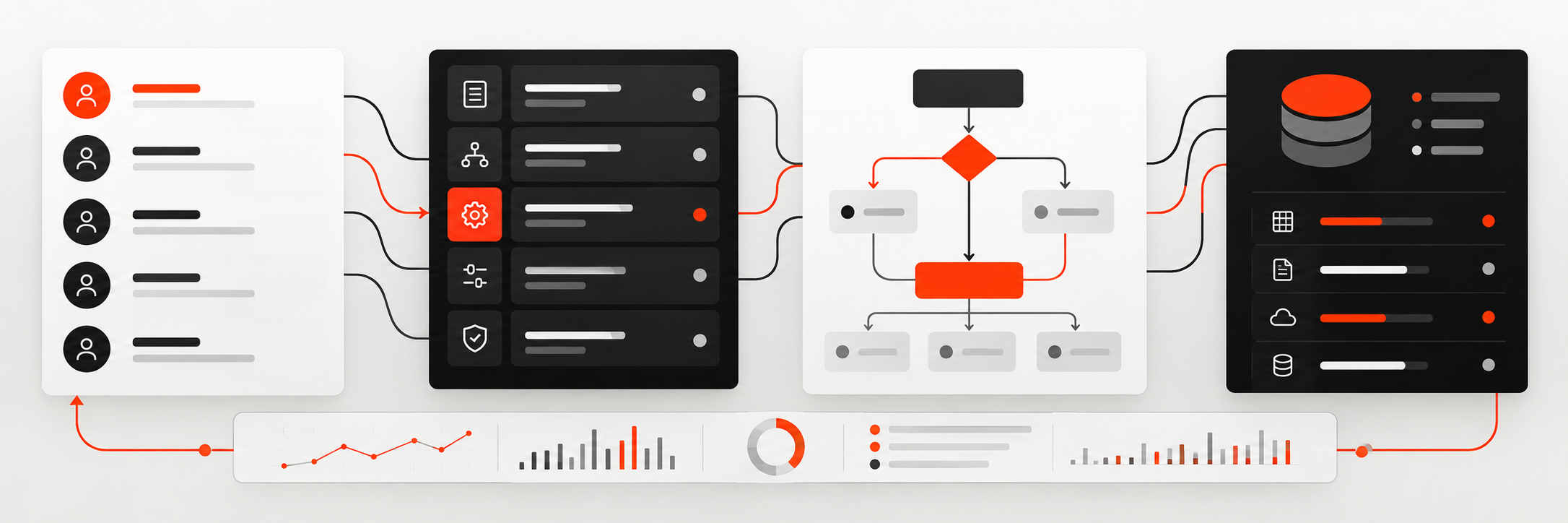
(01) Participants
Without defined roles, the team designs for “the user in general” and adds roles on top of finished screens.
(02) Decision points
Without this, the interface shows data but does not help make a decision.
(03) Scenarios
Without a complete set of journeys, development estimates the happy path while you pay for exceptions.
(04) Rules
Without a single source, a rule is duplicated in code, spreadsheets and agreements.
(05) Data
Without a data model, the team does not know which data to trust or where to fix an error.
(06) Boundaries
Without defined boundaries, development scope grows during implementation.
If even one level is not defined, the team compensates with assumptions for time design and development.
Entry point
Situation 01
We define roles, the core journey, rules, data and the first version.
Resultbasis for estimate to start development.
FormatArchitecture project
Situation 02
We verify contradictions, dependencies, exceptions, hidden decisions and journey completeness.
ResultA technical challenge does not give the team conflicting requirements.
FormatAudit architecture
Situation 03
We find decisions the team makes locally, repeated logic and places that will require future rework.
ResultWe fix the most expensive dependencies before the next part of the product is built.
FormatAudit architecture
Situation 04
We define where exceptions have accumulated, why changes affect the whole system and what can be fixed locally.
ResultA change plan without automatic decisions rewriting the entire product.
FormatArchitecture session or audit
Personal accountability
Constraintscan record a requirement without deciding whether it should become part of the product.
Constraintscan improve a journey without seeing all business rules and system dependencies.
Constraintsanswers “how to build”, but not always “which product model to build”.
Sheker.Agency’s position
Natalia Sheker connects the business model, user behaviour, product rules and implementation logic in one decision.
What she does personally
Leads key sessions · checks contradictions · defines boundaries · makes first-version decisions · explains consequences to the client team.
You work not with an intermediary collecting specialists’ opinions, with the expert responsible for the integrity of the product decision.
Reconstruct reality
ResultA realistic product model, not an idealised description of the process.
Artefact · “as is” process map and exceptions list
Agree the model
ResultAgreed product logic before screen-level detail.
Artefact · model roles, scenarios and rules
Prepare for implementation
Resulta basis for estimation, UI/UX and technical architecture.
Artefact · architecture handover package
What remains in team
Roles, interests and accountability.
Who sees, changes, approves and is responsible.
Where key decisions are made and what information they need.
Core, alternative and critical scenarios.
Terms, statuses, limits, exceptions and approvals.
What information exists, where it comes from and who manages it.
Which decisions affect other parts of the product.
What is included in the product, what remains in external systems and where accountability passes.
What scope is sufficient for launch or the next test.
What was chosen, which alternatives were considered and why they were rejected.
The basis for estimates, UI/UX, technical architecture and development.

The result can be handed to the internal team or another contractor. Further development with Sheker.Agency is not required to use the architecture.
After the stage, the team understands not only what to build, and which decisions cannot be changed locally without consequences for the entire product.
Formats and cost
01 · Architecture session{{requires approval}}
Price on request
Suitable if
Client gets
ClarificationA sufficient format, when needed test consequences one decisions.
Discuss a session02 · Product architecture audit2–4 weeks
from $5 000
Suitable if
Client gets
Clarificationshows what can be fixed locally and what requires redesign.
Discuss audit03 · Product architecture design4–6 weeks
from $10 000
Suitable if
Client gets
ClarificationFor complex B2B and enterprise systems, projects typically start at $15,000 after participants, rules and system dependencies are defined.
Discuss architecture{{Prices require approval by the Sheker.Agency owner before publication}}
Discuss the architecture
In the first conversation, we discuss the product, roles, rules, data and complexity the team sees. We define whether an architecture session, audit or full design is enough.
If the problem is local and does not require a separate architecture stage, we will say so before work begins.
The first conversation is with an expert personally responsible for the product model and the consequences of key decisions.
INFO@SHEKER.AGENCY+38 097 789 84 09
+38 098 698 94 77
Viber · Telegram · WhatsApp