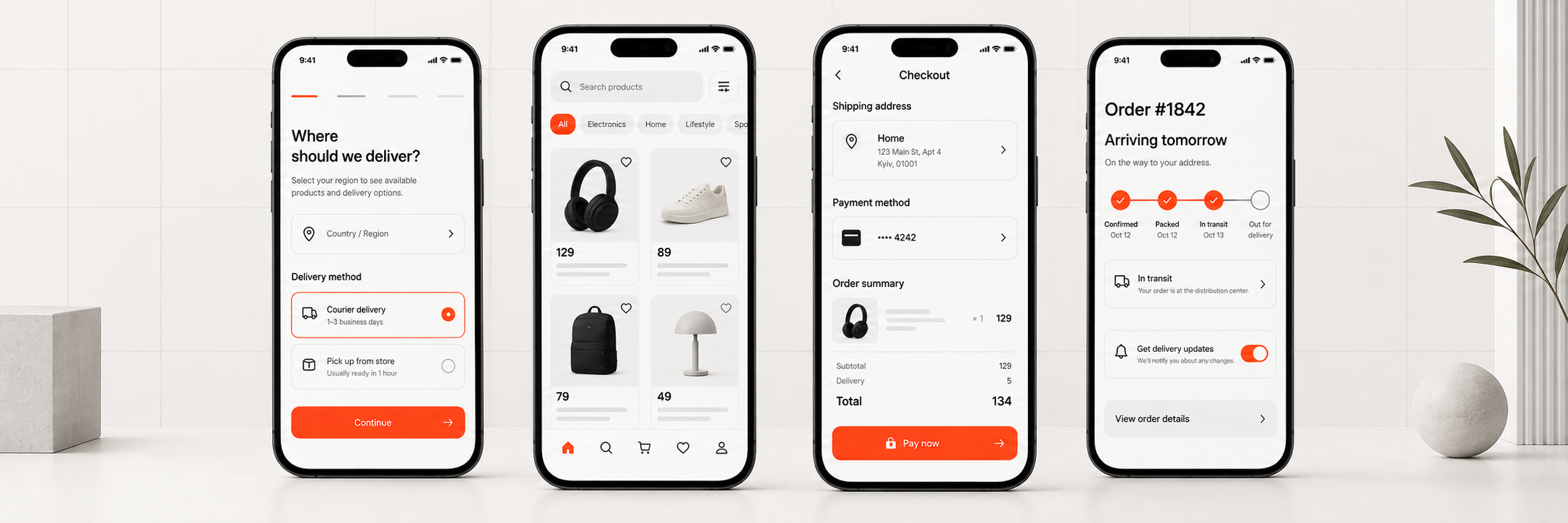
01First launch
Value in 20 seconds
Without mandatory registration or a long onboarding. The customer sees their region, delivery options and current prices before creating an account.
We develop mobile apps for online stores where purchases repeat. First, we calculate how many repeat orders the app must bring to pay for itself — and whether that is realistic.
The calculation before launch
This is the first thing we calculate in a meeting. If the numbers do not add up, we will say so before you spend the development budget.
4×
How many times per year your active client buys
+18{85c32a404beb3a17fad9859395e98171d5844d669a872c9f6728ab61e397d515}
How much more often app users buy
12 000
How many customers will actually install the app in a year
Yes / No
If the increase does not cover development and support over 18 months, we will recommend investing in the mobile website.
App – not channel acquisition. This is a retention tool for people you have already acquired.
Key screens
Without mandatory registration or a long onboarding. The customer sees their region, delivery options and current prices before creating an account.
Thumb-friendly filters, browsing history and saved lists. The same catalogue as on the website, with identical prices and stock.
Saved addresses and cards, Apple Pay and Google Pay, and one-tap reordering. The app must be faster than the browser here, otherwise it is not needed.
Order status, back-in-stock alerts and personal offers. A push notification is sent when it is useful, not on a marketer’s schedule.
Retention
Installs are easy to buy with advertising. Revenue comes from the share of people who open the app throughout the month. We design for this exact number and review it weekly after launch.
Day 1
100{85c32a404beb3a17fad9859395e98171d5844d669a872c9f6728ab61e397d515}
Day 7
42{85c32a404beb3a17fad9859395e98171d5844d669a872c9f6728ab61e397d515}
Day 30
24{85c32a404beb3a17fad9859395e98171d5844d669a872c9f6728ab61e397d515}
Day 90
16{85c32a404beb3a17fad9859395e98171d5844d669a872c9f6728ab61e397d515}
Benchmarks for products with recurring demand. For your category, we will calculate your own figures from store data, not market averages.
Technology
Works for most stores
One codebase for iOS and Android. Lower development cost, faster releases and lower support cost.
When the challenge requires it
Separate apps for each platform. More expensive, but with full access to device capabilities.
Data
The app works through the same API as the store. If there is no API, we build it as part of the work, not as an afterthought after launch.
API · ERP · 1C
Payments, delivery and returns follow the same processes as on the website. The customer sees the same information in every channel.
Payment · delivery · CRM
Your team configures segments and scenarios. We build the basics from the start: abandoned cart, back-in-stock alerts and repeat orders.
Push · Segments · analytics
01
30-minute meeting
Category, purchase frequency, customer base and current mobile version. We will say whether you need an app.
02
Economics and scenarios
Payback calculation, key scenarios, integration map, first-version scope and cost.
03
Design and development
One-handed interface, builds every two weeks, testing on real devices and store data.
04
Release and growth
Publication in the App Store and Google Play, analytics setup, retention monitoring and a change queue.
Cost
We estimate development after calculating the economics. Without this, any figure would be made up.
Economics and scenarios2–3 weeks
from $2 500
Payback calculation, scenarios, integration map and first-version plan with budget.
Development app3–5 months
from $18 000
First version for iOS and Android: catalogue, checkout, portal, push notifications and store publication.
Questions
For businesses with repeat purchases: recurring-demand products, subscriptions and frequently ordered services. If a customer buys once a year, the app will not pay back — it is better to invest the same money in the mobile website.
A first version with catalogue, checkout, portal and push notifications starts at $18,000. The exact figure depends on the number of integrations and how ready the product data is. Economic modelling before launch is a separate stage from $2,500.
For most stores, a cross-platform solution solves the challenge more cheaply and quickly. Native development is needed where complex graphics, camera work, offline mode or platform-specific capabilities are critical.
Through the same API as the website. There is one source of truth for prices and stock; otherwise the app will sell what is not in stock. If there is no API, we build it as part of the work.
From launch to store release usually takes 3–5 months: one month for planning and design, followed by development and testing. App Store and Google Play publication is a separate 1–3 week stage.
Your team manages segments, scenarios and schedules through the admin area, without a developer. We build the basics from the start: abandoned cart, back-in-stock alerts and repeat orders.
Start
A 30-minute online meeting with the founder. We will review the category, purchase frequency and customer base. We will send a written summary.