
01 · Documents
Review of invoices, contracts and delivery notes
It extracts details, amounts, deadlines and terms into a structured format and accounting system. Ambiguous fields are marked for testing rather than guessed.
We work on processes where the input is text or a document and the output is a structured field: invoice and contract processg, report preparation, enquiry routing and policy search. We calculate the hours first, then implement.
The arithmetic
An operation taking 15 minutes, performed 40 times a day, is 10 hours daily, or two full months of one person’s work per year. These processes are easy to overlook individually but visible in the budget.
If a process can be described by “if–then” rules, we propose ordinary automation without a model. It is cheaper, faster and more predictable.
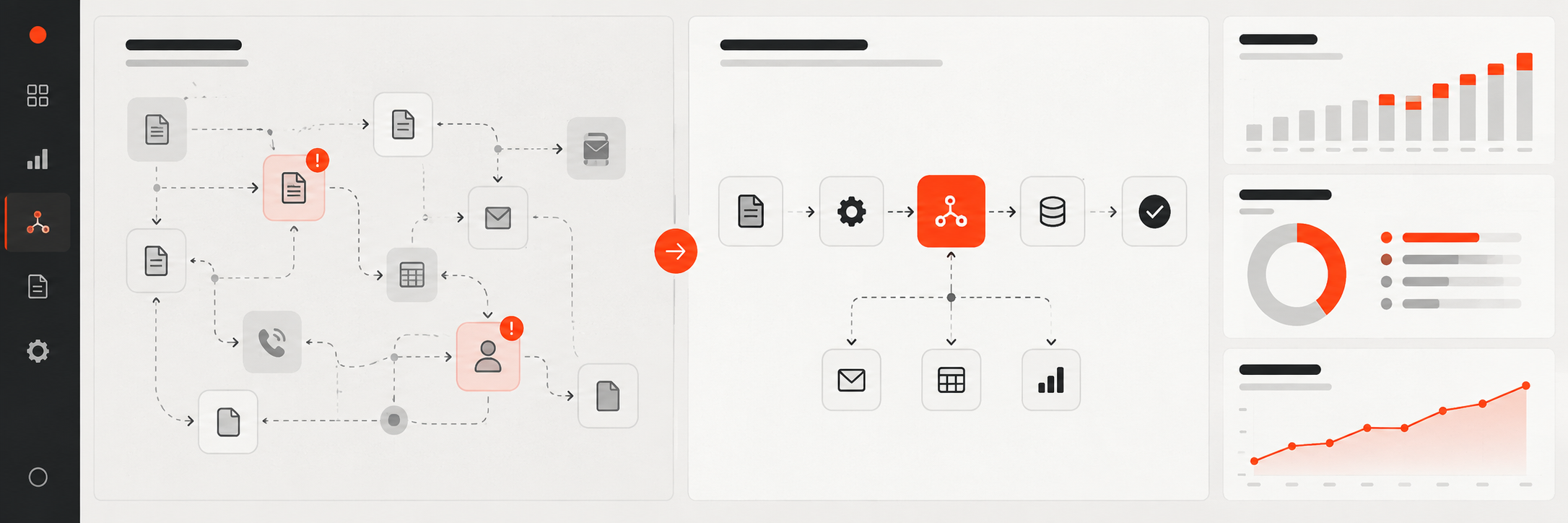
Scenarios
01 · Documents
It extracts details, amounts, deadlines and terms into a structured format and accounting system. Ambiguous fields are marked for testing rather than guessed.
02 · Reporting
A regular report is built from your sources, with a text explanation of what changed and why. The manager reads the conclusion instead of building a table.
03 · Enquiries
Incoming emails, tickets and internal queries are sorted by topic, urgency and owner. Duplicates are merged, and routine cases are closed with a template.
04 · Knowledge
A colleague asks questions in their own words and gets answers with links to the source document. Fewer requests reach colleagues and fewer decisions rely on memory.
Automating disorder only makes disorder faster. Process first, model second.
Pilot
We take a limited scope: one process with the highest number of repetitions. We compare it with how the process worked before.
We measure time per unit of work, the share of operations completed without edits, errors that required fixing and model cost. If savings are lower than the retention cost, we do not propose scaling.
Honest boundary
The model prepares a calculation or draft; a person approves it. We do not launch actions with financial or legal consequences automatically.
Approval step · Action log
An unreadable scan, non-standard form or conflicting data is not a reason to guess. Such items are marked and sent for manual review.
Confidence threshold · Review queue
We transfer the minimum data needed for the task, anonymized where possible. The model provider, processg region and retention period are agreed at launch.
Data minimisation · Retention policy
01
meeting 30 minutes
which processes hurt, how many people are involved, which systems are used and where delays occur.
02
Diagnosis and calculation
We measure operation frequency and duration, separate what rules can solve from what requires a model, and calculate savings for each scenario.
03
Pilot on one process
Work with mandatory human review, an edit and error log, and comparison with the baseline measurement.
04
Scaling and integration
Integration with accounting systems and storage, a team runbook, and monitoring of quality and model costs.
Cost
Payment for models and third-party services goes to providers according to actual usage.
Process diagnosis2–3 weeks
from $2 000
Measurement of current operations and a scenario queue ranked by savings, cost and risk.
Pilot and implementation4–6 weeks
from $4 000
One key process with quality control and integration into your systems.
Questions
Standard automation works where a process is described by rules: if a field equals a value, perform an action. AI is needed where the input is text, a document or unstructured data and a person repeatedly makes a decision based on meaning. If rules can solve the challenge, we say so — it is cheaper and more reliable.
We start with work performed often, taking many minutes per item and having an acceptable cost of mistakes. We leave rare, complex processes with expensive mistakes to people — the savings would not cover the risk.
Accuracy is high for standard forms and lower for poor-quality scans and non-standard forms. Therefore, the process includes a test: ambiguous fields are flagged and sent to a person instead of passing silently.
Usually not. We work with what already exists: the accounting system, CRM, email and document storage. Replacing systems is a separate decision, and we do not propose it merely to implement AI.
The process is built so that consequential decisions remain with a person: the model prepares and a colleague approves. For each scenario, we define what must be checked and what may pass automatically.
Diagnosis takes 2–3 weeks; a pilot with one process takes 4–6 weeks, including before-and-after measurement. Further scaling depends on what the figures show.
Start
A 30-minute online meeting with the founder. We will review the two or three hardest processes and the systems they use, then send a written summary.