
01 · Catalogue
Product content based on brand templates
Descriptions, short announcements, translations, SEO titles and metadata for thousands of product cards. Facts come from your data; the text follows your rules.
Descriptions and specifications for a large assortment, supplier data normalisation, search that understands buyers’ language and answers to common availability and delivery questions. All based on your data and checked before publication.
The arithmetic
A catalogue of 20,000 products, with eight minutes spent describing each card, means more than 2,500 hours of manual work. Support handling 300 similar enquiries a day takes another full working day every day. This is where AI can create a measurable financial impact.
If you have 200 products and ten enquiries a day, we will say that AI will not pay off here and suggest ordinary improvements instead.
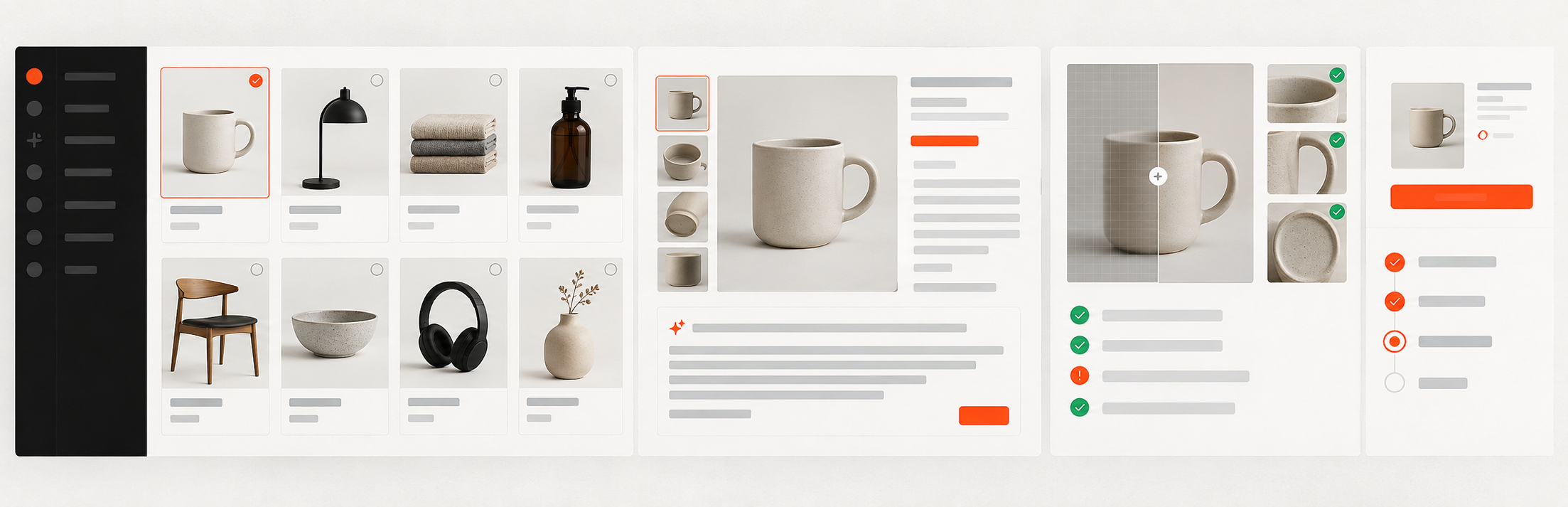
Scenarios
01 · Catalogue
Descriptions, short announcements, translations, SEO titles and metadata for thousands of product cards. Facts come from your data; the text follows your rules.
02 · Data
Standardising names, units, brands and attributes, detecting duplicates and matching them to your catalogue.
03 · Search
Synonyms, spelling errors and queries such as “something for a country house under 2,000”. Fewer empty results – more product pages per session.
04 · Support
The assistant works with the catalogue and accounting, shows order status and hands complex cases to a manager with ready context.
AI does not replace a category manager. It removes the mechanical part of the work..
Pilot
We take a limited scope: one product category or one enquiry channel. We compare it with the previous way of working.
For the catalogue, we measure time per product card and the share of edits after testing; for support, the share of enquiries closed without a person and first-response time. If the figures do not improve, we do not propose scaling.
Honest boundary
These data come from the supplier’s catalogue or documents. The model formats and describes them but does not invent product parameters.
Source data · Validation before publication
The assistant does not negotiate prices or promise timelines outside the rules. Such requests go to a manager.
Answer rules · Escalation
We transfer the minimum data needed for answers, anonymized where possible. The provider and processg region are agreed at launch.
Data minimisation · Retention policy
01
meeting 30 minutes
Catalogue size, data sources, enquiry scope and who performs this work now.
02
Diagnosis and calculation
How many hours operations take now, which scenarios are realistic on your data and what must be organized before launch.
03
Pilot on a limited scope
One category or channel, human-reviewed work, and a log of edits and errors.
04
Scaling and integration
Connection to the store, accounting and enquiry channels, team training, and quality and cost monitoring.
Cost
Payment for models and third-party services goes directly to providers for actual usage.
Diagnosis for storeOne-off
from $1 500
Savings estimate for catalogue, search and support scenarios based on the state of your data.
Pilot and implementation4–6 weeks
from $4 000
One key scenario with quality checks and store integration.
Questions
Not for specifications or compatibility: an error in a parameter causes returns. We use generation for drafts and repetitive blocks, while facts come from your catalogue or supplier feed with mandatory validation.
Not when answers are based on your data: stock, prices and statuses come from the catalogue and accounting system at query time. Questions outside the source are passed to a manager, not invented.
The direct effect is usually better catalogue search and faster answers to buyers. We do not promise a specific percentage; we record a baseline and show the actual change after launch.
Access to the catalogue and feed, delivery and returns rules, and a history of typical enquiries. The more organized the data, the smaller the preparatory-work scope.
Payment for the request scope plus support scenarios. For a store with a large catalogue, we calculate cost per 1,000 products or enquiries so the economics are visible.
Yes, and we recommend exactly that: one process, limited scope, measurement and only then expansion to the rest of the catalogue or channels.
Start
A 30-minute online meeting with the founder. We will review the catalogue, supplier data and enquiry flow, then send a written summary.