
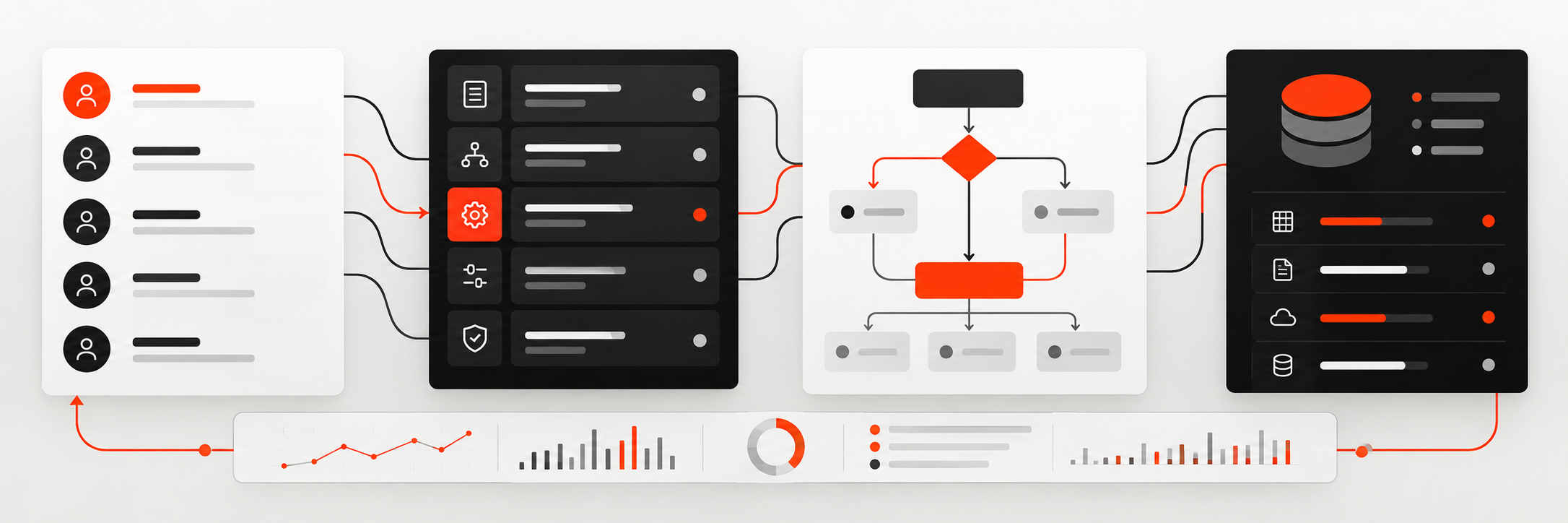
SaaS where every new client adds profit, not cost.

We define recurring value, the user journey, pricing and configuration boundaries before you invest in full development.

Segment · Value · Activation · Usage · Monetisation · Retention

“We need a SaaS with subscriptions, portals and plans” One product for many customers, not a separate version for every sale

The problem is not the lack of features

SaaS becomes expensive not when it has few capabilities, but when every new client requires a separate product version.

At first, customisations help close a sale. But each new client adds separate rules, roles, setup and exceptions to the product.

We first determine what should remain common in the product, what can be configured and what should never become part of the SaaS.

How this feels with the tenth client

The team supports several versions of one scenario, releases need more testing and a simple update affects customers differently.

Revenue grows, but support costs grow with it.

If every sale creates a new product version, you are scaling custom software, not SaaS. You are scaling custom development.

SaaS model: one product, many companies, roles and pricing on a shared foundation

Segment · roles · pricing · shared architecture · recurring revenue

Architecture · SaaS economics

SaaS economics are determined not by the first release, but by onboarding, support and growth costs. each next client.

You can launch quickly but leave manual setup, individual permissions, custom pricing and separate scenarios for each company. Then every new contract brings not only revenue, but also a new permanent cost.

The product is sold separately to each customer

Complexity grows with sales

  • features are added for specific deals
  • onboarding depends on a person
  • pricing does not reflect real differences in value
  • client-specific rules enter the shared logic
  • support explains the product manually
  • every release requires testing every exception

New customers increase revenue but raise support costs and slow growth

Investing in a repeatable model

Each onboarding is cheaper than the previous one

  • a specific segment is selected
  • a shared recurring need is defined
  • the path to first value does not depend on manual work
  • Plans are tied to real levels of value
  • configuration has clear boundaries
  • data and roles have a shared model

Improvements remain part of one product, not one customer’s version

SaaS architecture determines whether margin will grow with the customer base.

When product architecture is needed

Strategy is needed when the product can no longer evolve. one feature list for all customers.

  1. 01

    Different customers require different scenarios

    Without a shared model, every contract creates a new product branch.

  2. 02

    Sales depend on promises of customisation

    The team gets revenue now but creates future implementation and support costs.

  3. 03

    Onboarding requires a specialist’s involvement

    Onboarding costs grow with the number of customers.

  4. 04

    The user does not reach first value quickly

    The budget goes to acquisition, but the client does not reach the moment for which they bought the product.

  5. 05

    Pricing differs only by the number of features

    The client does not see the connection between price and received value.

  6. 06

    A change affects customers unpredictably

    Releases slow down, while testing and support costs grow.

Full custom SaaS development is not needed if a standard platform can test the model without critical limitations or costly workarounds.

We are needed where a mistake in the product model will cost more than designing it.

Strategy → architecture

Strategy defines the recurring value the client pays for. Architecture how to provide it without separate development for every company.

  1. 01SegmentFor which type of companies the problem is similar enough. Less budget scattered across conflicting needs.
  2. 02First valueWhat result the user should get immediately. A shorter path from acquisition to real use.
  3. 03Core scenarioWhich repeated action creates value. The first version focuses on behaviour people pay for.
  4. 04Roles and dataHow the company and team work in a shared model. A new client type should not require rebuilding the foundation.
  5. 05ConfigurationWhat the client configures themselves without changing shared logic. Less manual work during onboarding.
  6. 06Monetisation and retentionHow plans and limits relate to value. Price grows with the benefit, not with the feature list.

01 · B2B SaaS

The company buys the product, while different roles use it.

  • Model:A company subscription with multiple users and access levels.
  • Architectural questions:What is the billing unit: the company, a user or usage scope?
  • Most expensive risk:the role that makes the purchase does not get value from the product

SaaS architecture is a product model, is fixed in segments, roles, pricing, rules and data.

Method

Before the first mockup, determine what repeats in the product for all customers and what does not should never become a feature.

Nata Sheker is personally responsible for the product model, first-version boundaries and architectural decisions that determine the cost of further SaaS growth.

You discuss the product not with a manager who passes requests to the team, but with a person responsible for the link between the revenue model, user behaviour and architecture.

  1. 01

    We define the segment and problem

    We find a group of customers with a sufficiently similar recurring need. The budget is not split between products for different audiences.

  2. 02

    We design the path to first value

    We define what the user must do and receive after onboarding. The team does not spend time on onboarding that could be part of the product.

  3. 03

    We build a shared model

    We connect the company, roles, data, scenarios and permissions. New customers join the product instead of creating a separate version.

  4. 04

    We define configuration boundaries

    We separate setup, pricing constraints and custom development. Sales does not create hidden debt in the roadmap.

  5. 05

    We shape the first version

    We keep only what is needed to test activation, regular use and willingness to pay. The client gets an answer about the main risk faster.

I – Model

Product model

Who pays, for what recurring value and why they continue using it.

II – Boundaries

Boundaries product

What is shared, configurable and should never become part of the SaaS.

III — Consequences

Consequences of decisions

How today’s compromise affects onboarding cost and release speed.

The goal is not to launch more features, but to verify the model. It is to test whether one product can repeatedly create value for many customers.

Result stage

After strategy and architecture, you know who the SaaS is for, what the client will pay for and which part of the product is worth developing first.

  1. 01

    Target-segment model

    Who has a recurring problem and why they are ready to change their usual way of working.

  2. 02

    Value model

    What result the client gets and what they are willing to pay for.

  3. 03

    Path to activation

    How the user reaches first value without the team’s involvement.

  4. 04

    Core usage scenario

    Which recurring behaviour creates value for the client and product.

  5. 05

    Organisation, role and data model

    How many companies work inside one product.

  6. 06

    Configuration boundaries

    What is configurable, what depends on the plan and what should never become part of the product.

  7. 07

    Monetisation model

    The logic of plans, limits and expanded usage.

  8. 08

    Boundaries first version

    The minimum scope sufficient to test the main hypothesis.

  9. 09

    Risk map

    Assumptions that may affect budget, timelines and model viability.

  10. 10

    Basis for estimating development

    An agreed product model instead of a wish list.

First-stage artefact: value model, activation journey and configuration boundaries

Materials the client keeps after the first stage

The result has standalone value and does not oblige you to order further development from Sheker.Agency. After this stage, you know not only what to create, but why it is worth paying for now.

Enterprise-context

To sell SaaS to companies, meeting the user’s need is not enough. The product must meet the organisation’s requirements.

I

Organisations and permissions

Companies, departments, teams, roles, administrators and access control.

II

Data and security

Isolation, accountability, import, export, deletion, access policies and audits of critical actions.

III

Integrations

CRM, ERP, analytics, documents and other client systems.

IV

Procurement and approval

What information IT, security, legal and finance departments require.

V

Onboarding and migration

How to migrate data and connect a company without a long manual project.

VI

Support and accountability

What the client can decide independently and where a product team is needed.

Enterprise-ready is not a single tier. It is the product’s ability to meet organisational requirements without creating a custom version for every client.

After launch

Launch shows that the product works technically. Customer behaviour shows whether its business model works.

01

Who reaches the first value

02

Where users stop during onboarding

03

Which features are used regularly

04

Where the team’s manual help is needed

05

Which requests repeat across clients

06

Which requests remain individual

07

What affects willingness to continue using it

08

What additional value customers are willing to pay more for

When needed, we work with the internal product team and transfer the context of strategic and architectural decisions.

The next budget goes not to loud requests from individual customers but to changes that strengthen the shared product.

Typical situations

Three product decisions that change SaaS economics.

We do not publish customer metrics or internal data. We show the decision logic and economic consequence.

Every client required separate logic

The starting problem

Early deals were closed with promises of customisation, and parallel versions of one scenario appeared in the product.

Superficial decision

Continue implementing requirements for every contract and add feature switches without a shared model.

Product questions

Which of these requirements is a shared segment need, and which is an individual company process?

Architectural decisions

Extract the shared journey core, describe differences as rule-based configuration and keep the rest outside the product boundaries.

Economic consequence

Releases no longer depend on the number of exceptions, and new customers join the shared product.

Long manual onboarding

The starting problem

Connecting a new client takes a specialist’s time: setup, data import and team training.

Superficial decision

Expand the onboarding team and document the process.

Product questions

Which part of setup can be removed so the user reaches first value?

Architectural decisions

Reduce mandatory setup to a minimum and move the rest to post-activation configuration.

Economic consequence

Onboarding cost stops growing in proportion to the number of customers.

Enterprise SaaS with conflicting roles and pricing

The starting problem

Pricing is split by features, but different roles receive the value and a third party pays.

Superficial decision

Add another tier and move disputed features to the more expensive package.

Product questions

What exactly does the organisation pay for, and how is it connected to user behaviour?

Architectural decisions

Connect plans to value levels and usage, and build organisational requirements into the permissions model.

Economic consequence

The product grows with usage, not through selling additional features.

Format and cost

We assess not number features, and model product and A development scope sufficient to test its economics.

Strategy and architecture SaaS4–6 weeks

from $10 000

A product model fixed before development starts.

  • Segment and value model
  • Path to first value and key scenario
  • Organisations, roles and data
  • Configuration boundaries and monetisation model
  • First-version boundaries, risk map and estimate basis

The stage has standalone value and does not oblige you to order further development.

Send an enquiry

Development SaaS-productfrom 12 weeks

Custom scope

Typical projects start at $60,000. The exact budget is determined after the strategy and architecture stage.

  • Number of segments
  • Model of organisations, roles and pricing
  • Configuration, data and integrations
  • Security and migration
  • Enterprise requirements and uncertainty level

A product is not estimated by feature count.

Send an enquiry

{{prices require final approval from the Sheker.Agency owner before publication}}

Enquiry

Before estimating SaaS development, determine what repeatable value the client receives and how much it will cost to provide it to each additional company.

In the first conversation, we discuss the segment, need, path to first value, monetisation model and main risks. We define what must be tested before full development and where a ready solution or manual test is enough.

If the product does not yet require custom development, we will say so before costs begin.


    We will send confirmation and a meeting link. No presentations – straight to your numbers.

    The first conversation is about the revenue model, operating cost and first-version boundaries — not about selling the largest possible development team. Project materials will not be published or shared with third parties.

    INFO@SHEKER.AGENCY+38 097 789 84 09
    +38 098 698 94 77
    Viber · Telegram · WhatsApp